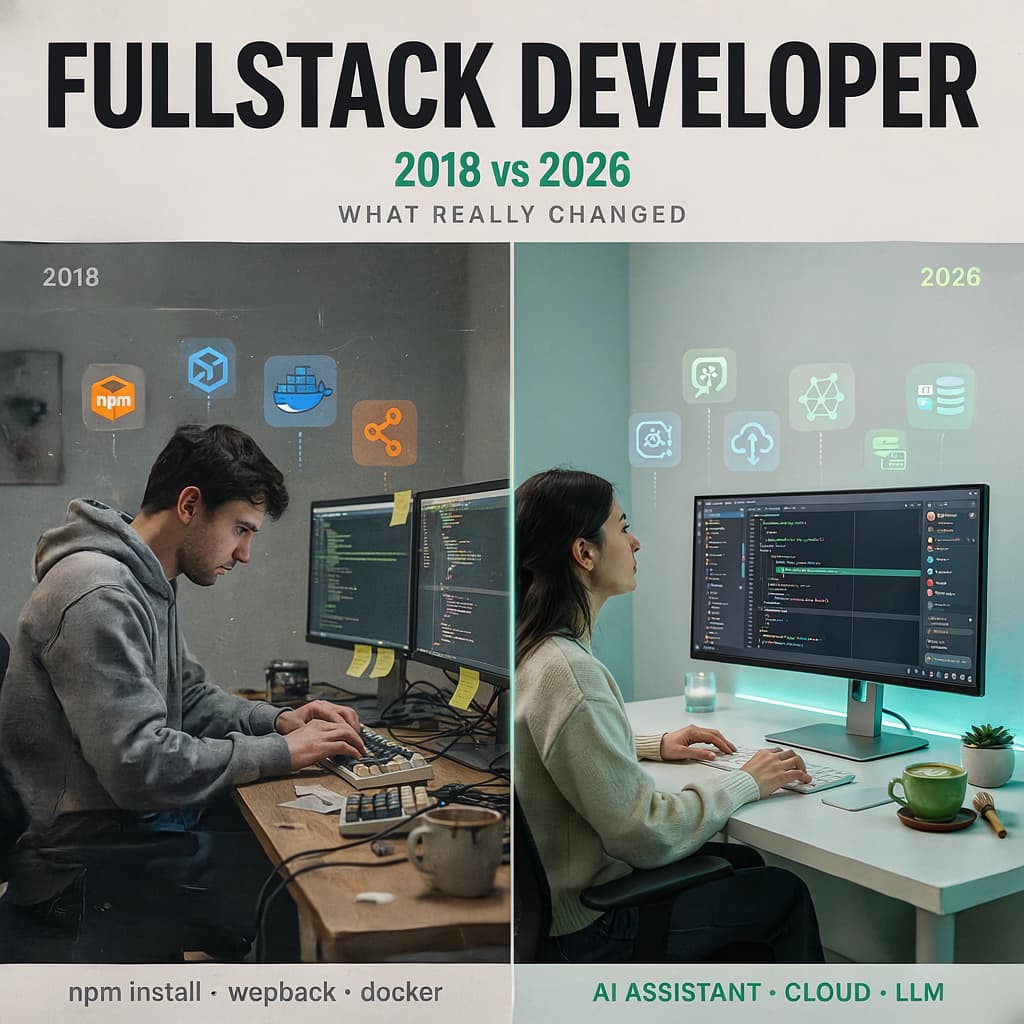
Fullstack Developer Job: 2018 vs 2026 - What Really Changed
Fullstack in 2026 means cloud, AI, and DevOps - not just frontend and backend. Here is what changed since 2018 and what stayed the same.
The 2018 Fullstack Developer
In 2018, being "fullstack" mostly meant comfort on both sides of the request/response cycle:
- Frontend: React, Angular, or Vue, plus vanilla JS, HTML, and CSS
- Backend: Node.js, Python (Django/Flask), Ruby on Rails, or PHP
- Database: MySQL/PostgreSQL, with MongoDB for the NoSQL crowd
- Deployment: Manually spinning up a server, maybe Heroku, maybe a shared host
- Version control: Git, usually GitHub
- The bar for "senior": knowing enough backend and frontend to ship a feature without handing it off
DevOps existed, but it was often a separate role. Cloud was AWS/Azure basics - EC2, S3 - not a fluency requirement. AI for most developers meant maybe calling a third-party API, not building with it daily. Interviews leaned hard on algorithms and whiteboard coding.
The 2026 Fullstack Developer
The core skill is the same: move across the stack without waiting on a handoff. But the stack got taller, and the expectations got wider.
You own the full lifecycle, not just the code.- Translate product requirements into working features
- Make decisions on architecture, performance, and scalability
- Collaborate directly with designers and stakeholders
- Set up and maintain CI/CD pipelines
- Write automated tests and monitor production
- Deploy to cloud environments, not just "push to Heroku"
- Use AI coding assistants (GitHub Copilot, Cursor) to move faster
- Build products with AI features built in
- Staying competitive means using these tools, not avoiding them
- Understand how your code affects cost, scale, and reliability
- Know how the frontend, backend, database, and cloud services connect
- The role is cross-functional engineering, not just "a bit of both sides"
- Know how your app runs after it leaves your machine
- Understand environments, secrets management, and managed services
- You do not need to be a DevOps specialist, but you cannot ignore it
- Communication and collaboration drive career growth
- Problem-solving ability is what employers prioritize most
- Technical depth gets you the interview; everything else gets you the job
Side-by-Side: 2018 vs 2026
| Area | 2018 | 2026 |
|---|
| Core stack | React/Angular/Vue + Node/Python/Rails + SQL/Mongo | Same frameworks, but TypeScript-first is now expected |
| Deployment | Manual server setup, basic PaaS (Heroku) | CI/CD pipelines, cloud-native, serverless, containers |
| AI involvement | Rare, optional, a bolt-on API call | Daily - AI coding assistants, AI-integrated features |
| DevOps | Often a separate team/role | Expected baseline skill for the fullstack role |
| Security | Addressed later, by a security team | DevSecOps - built into the pipeline from the start |
| Scope | Feature-level: build frontend + backend for a task | System-level: understand cost, scale, reliability |
| Hiring | Algorithms, whiteboard coding | Problem-solving, business impact, adaptability |
What Has Not Changed
Some things are stable:
- Fundamentals still matter most. HTTP, databases, data structures, and clean architecture are still the foundation.
- Git and collaborative workflows are still central.
- The core value of "fullstack" - moving across the stack without a handoff - is the same pitch it was in 2018.
- Continuous learning was always required. The learning curve just got steeper.
What This Means If You Are Job Hunting in 2026
If your skills stalled around a 2018 stack, the gap is not about learning a new framework. Most frameworks (React, Node, Python) are still relevant. The gap is in three areas:
The role title has not changed. What "qualified" means underneath it has.